Methods, tools, and teaching notes
Self-contained, citation-free walkthroughs for the methods we use across our research and teaching. Each guide is a single HTML page you can read, link, or fork.
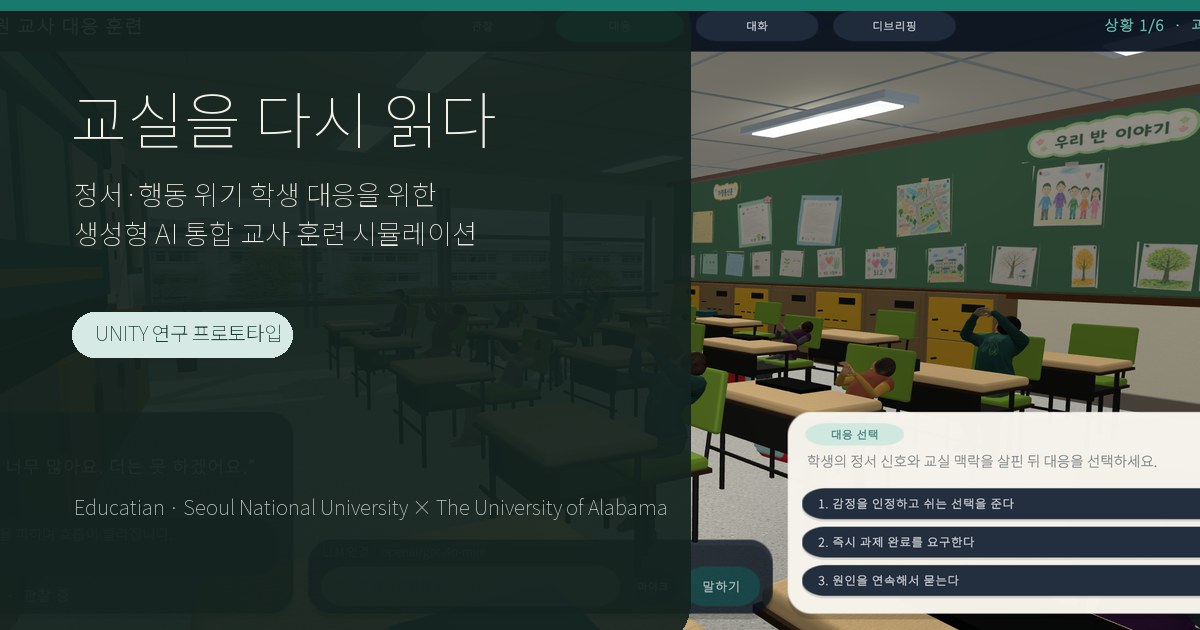
Teacher Response Simulation: reading the classroom again →
A Korean-first project page for a Unity research prototype that helps teachers practice responding to students in emotional and behavioral crisis. Introduces the research purpose, working interaction evidence, four research tracks, three-year roadmap, core Korea-US team, and explicit ethical boundaries.
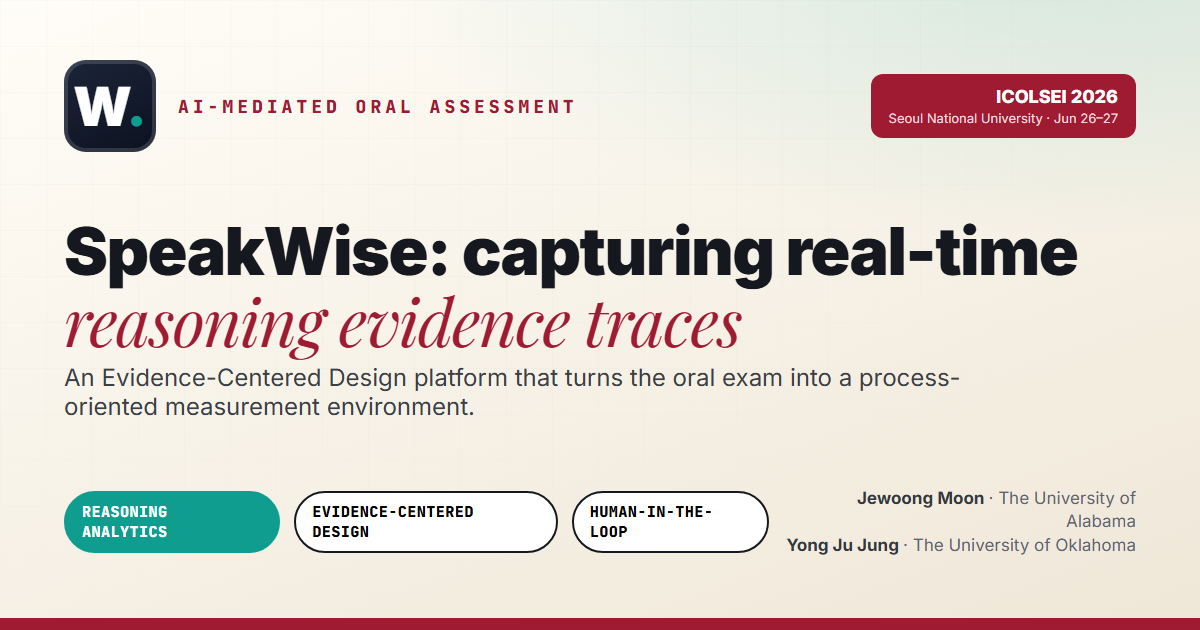
SpeakWise — reasoning evidence traces through AI-mediated oral assessment →
A project page for SpeakWise, an Evidence-Centered Design platform that reframes the oral exam as a process-oriented measurement environment. Covers the problem and research questions, the four-stage ECD pipeline, the four reasoning-evidence-trace types, instructor sensemaking, the current React 19 / Supabase / Gemini Live / Cloudflare architecture, end-to-end student and instructor workflows with narrated demo videos, and the ICOLSEI 2026 poster. Live app + walkthrough guide linked. Jewoong Moon (UA) & Yong Ju Jung (OU).
TeacherGen@I v1.6 CAT 531 Student Guide →
Student-facing access guide for TeacherGen@I v1.6. CAT 531 students find their name, enter the assigned 4-digit PIN, confirm the matched name, and continue to the setup screen.
Educatian Style Guide →
A practical style guide for Educatian research tools, guidebooks, dashboards, prototypes, and public artifacts. Covers identity tokens, layout rules, reusable components, writing voice, research-safety boundaries, artifact types, implementation conventions, and pre-publication gates.
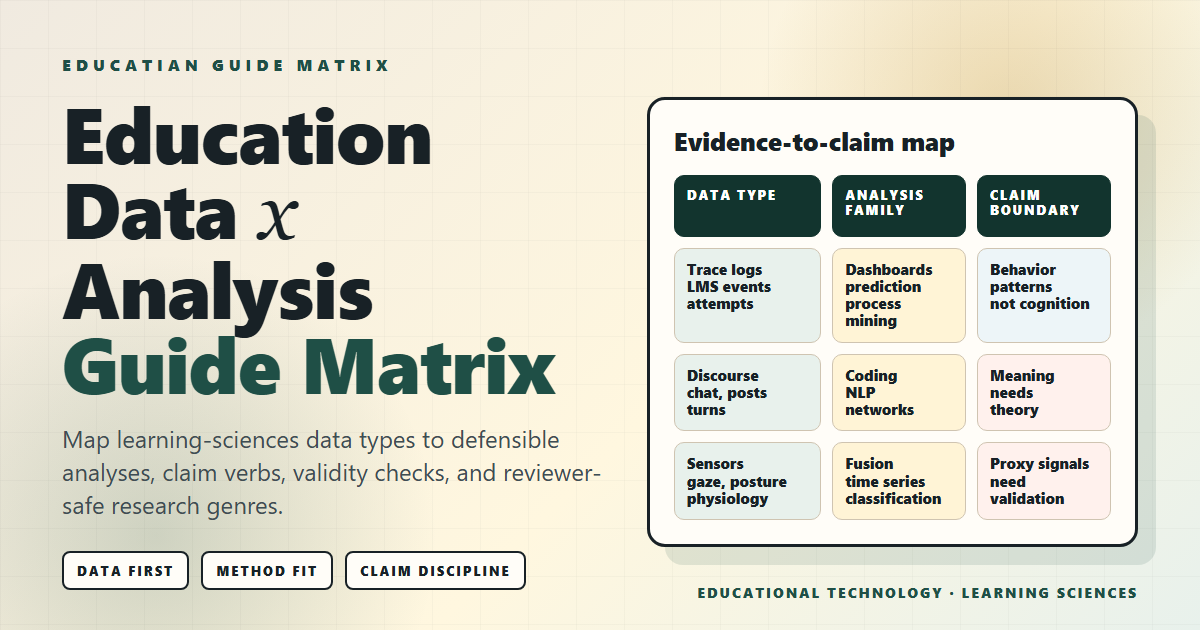
Education Data x Analysis Guide Matrix →
A practical map of educational technology and learning-sciences data types: surveys, assessments, trace logs, sequences, text, discourse, networks, video, sensors, artifacts, interventions, and institutional records. Includes an interactive data-type × claim × method selector, reviewer-risk clinic, worked examples, and downloadable templates.
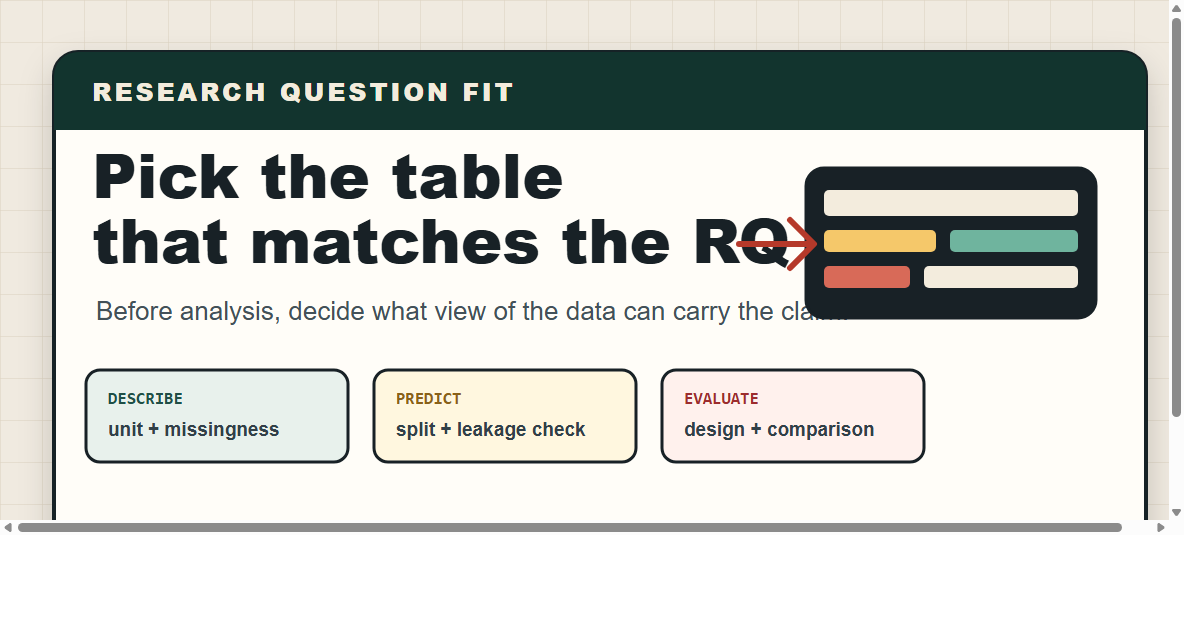
Research Question Fit →
A practical decision guide for matching research questions to the data, design, measurement, and validity evidence needed to support them. Includes an interactive question-verb × data-type fit gate, claim wording clinic, reviewer objection bank, agent-ready prompt, and public-safe starter downloads.
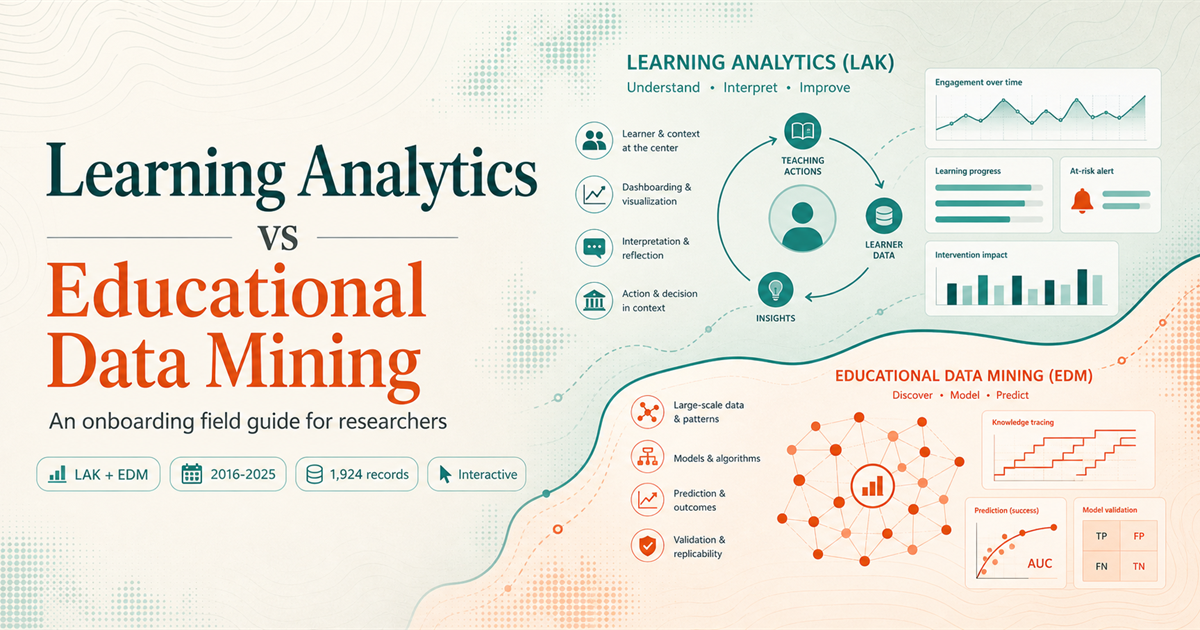
Learning Analytics vs Educational Data Mining →
An English onboarding guide comparing LA and EDM through 1,924 LAK/EDM proceedings records, MPNet embeddings, BERTopic topics, field-background explanations, interactive trend visualizations, common beginner mistakes, and a venue-framing decision tool for educational technology researchers.
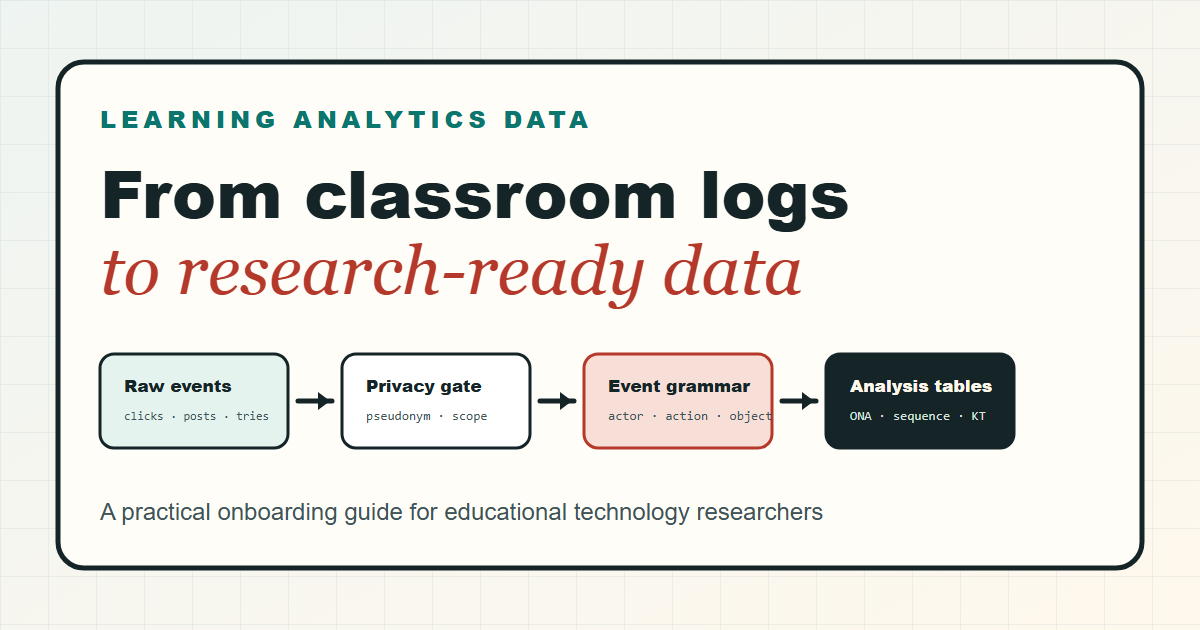
From Classroom Logs to Research-Ready Learning Analytics Data →
A practical English guide for turning LMS clicks, assessment attempts, discussion posts, video events, and simulation traces into privacy-safe, analysis-ready learning analytics datasets. Includes event grammar, privacy gates, source-system risks, sequence/ONA/KT fit logic, visualization matrix, Sankey/pathway comparison rules, reviewer-risk wording, and public-safe starter downloads.
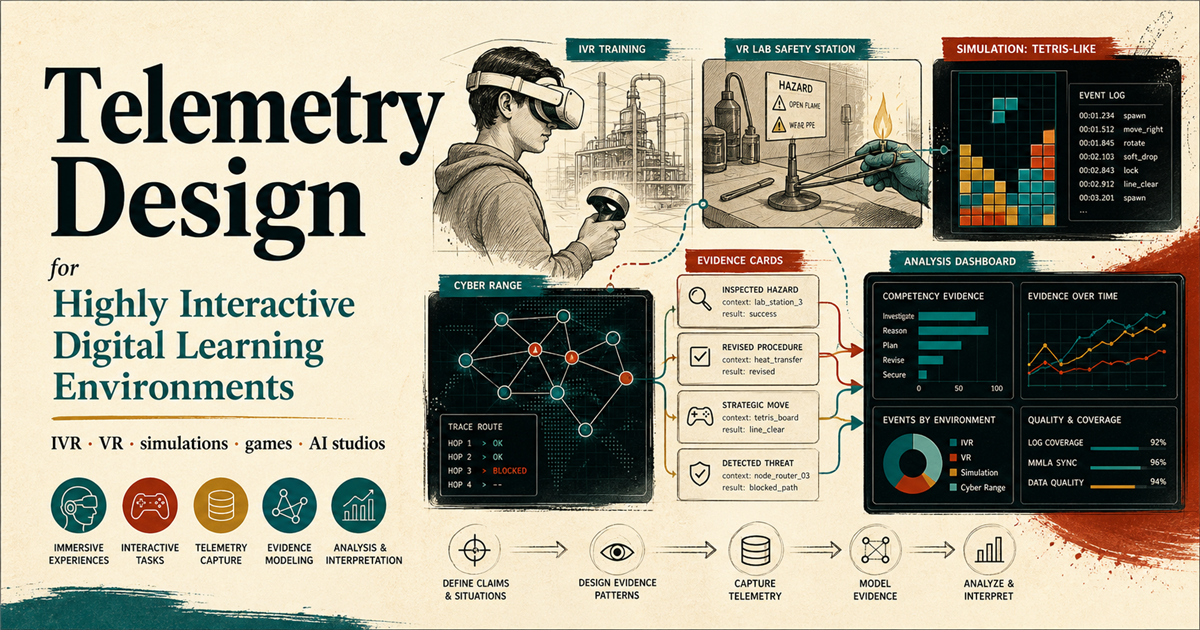
Telemetry Design for Highly Interactive Digital Learning Environments →
A visually rich guide to what to log before an IVR simulation, VR lab, AI studio, cyber range, or other interactive learning environment becomes impossible to study. Includes ECD, MMLA, privacy, xAPI/Caliper mapping, a live Tetris-like trace simulator, and public-safe starter telemetry templates.
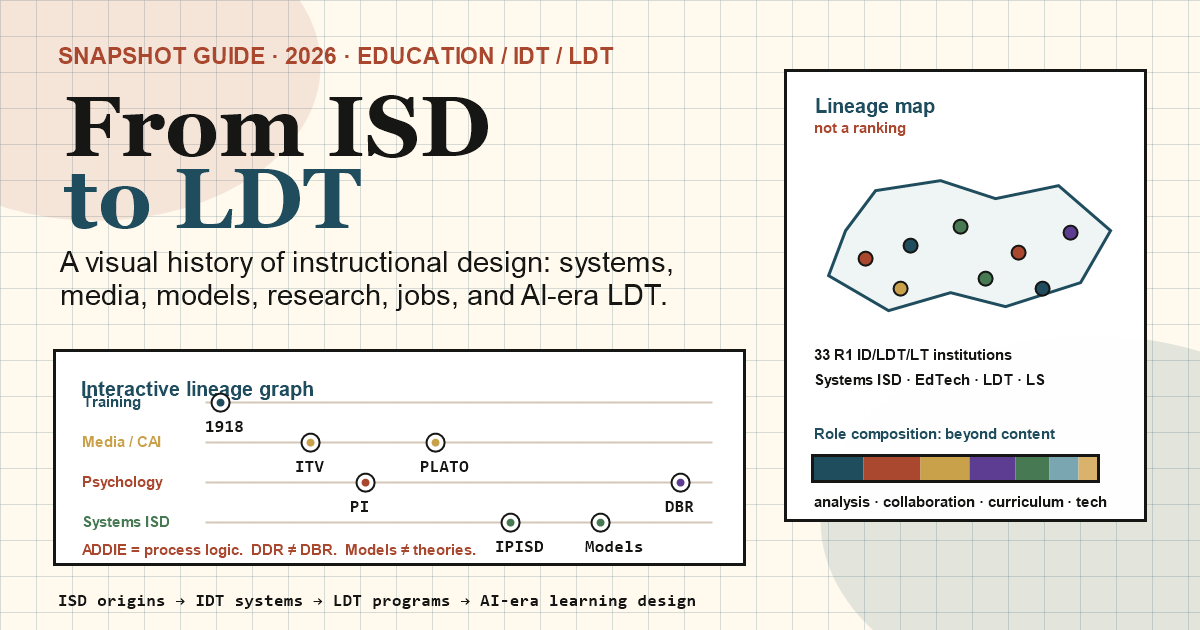
From ISD to LDT →
A beginner-friendly visual guide to how instructional design grew from industrial and wartime training systems into contemporary Learning Design and Technology. Includes an interactive lineage graph, model/theory confusion decoder, DDR/DBR distinction, job-role visualization, and institutional lineage map.
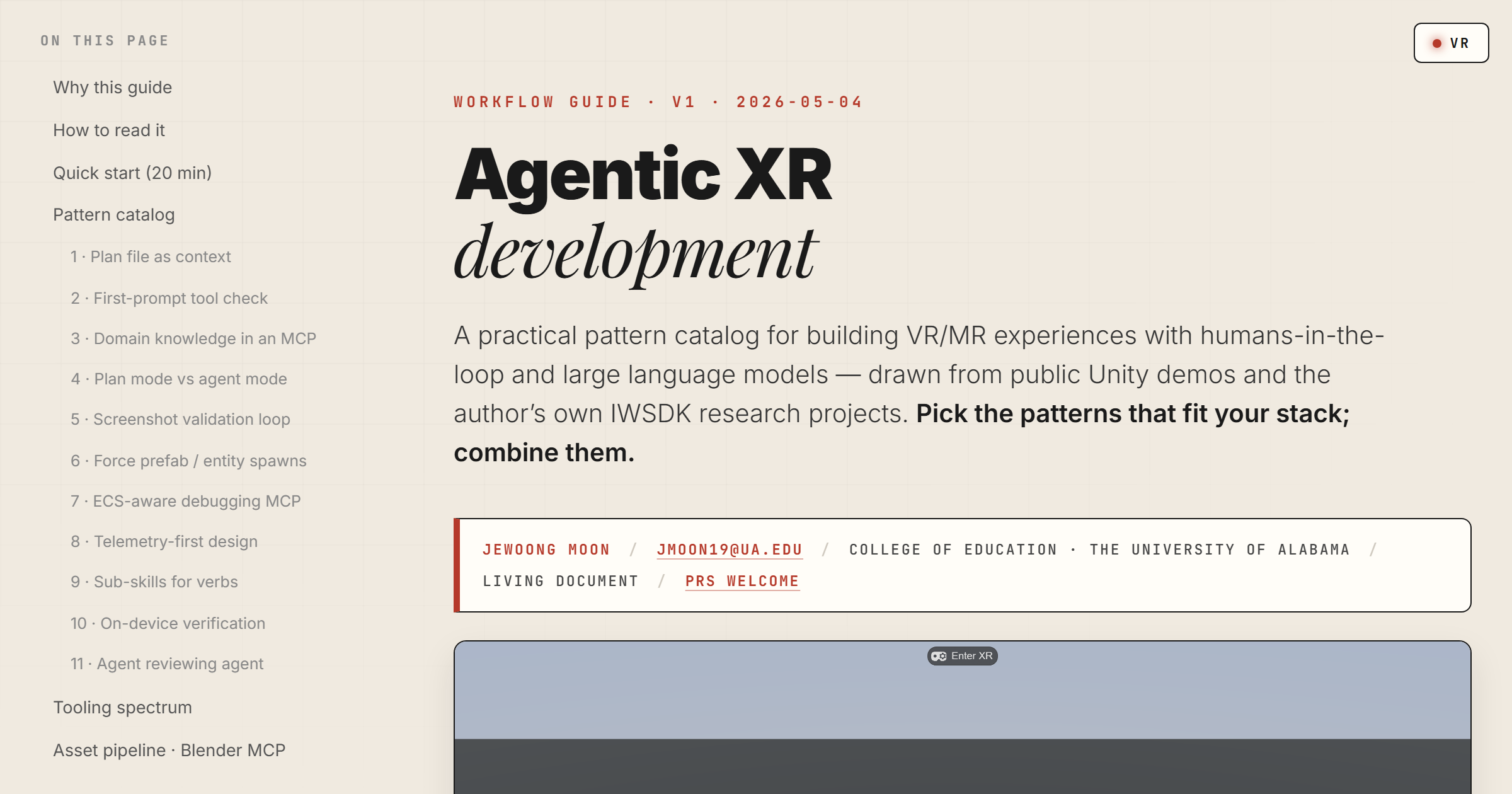
Agentic XR development →
Eleven patterns for building VR/MR with humans-in-the-loop and large language models. Plan files, custom-tool checks, domain MCPs, screenshot loops, ECS-aware debugging, agent-reviewing-agent — illustrated through Unity (Dilmer Valecillos’ basketball MR), IWSDK (Virtual Makerspace, Circuit Playground), Three.js browser games, and the GPT-5.5 vibe-coding wave from X. Includes a Quick Start, Blender MCP asset pipeline, agentic failure-mode catalogue, researcher-specific concerns, glossary, and public-safe starter templates.
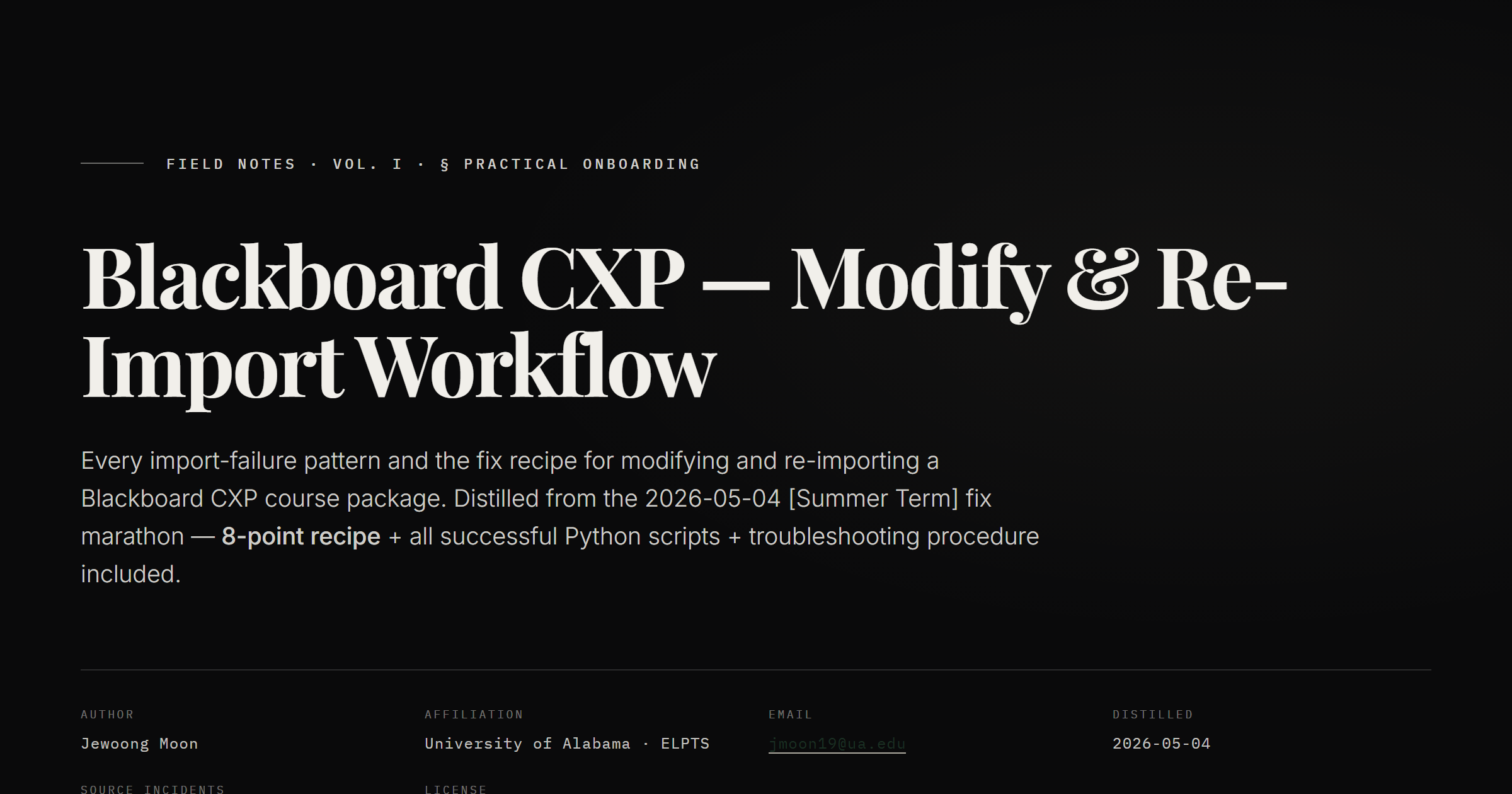
Blackboard CXP Modify & Re-Import Workflow →
Diagnose and fix the eight defect classes that surface when a Blackboard ULTRA course archive is exported, edited, and re-imported. Convert-time errors, silent runtime failures, ULTRA × classic-QTI conflicts, and the multi-line FLAGS regex trap — with a downloadable Claude Code / Codex CLI skill bundle and eight pure-stdlib Python fix scripts. KO ↔ EN toggle.
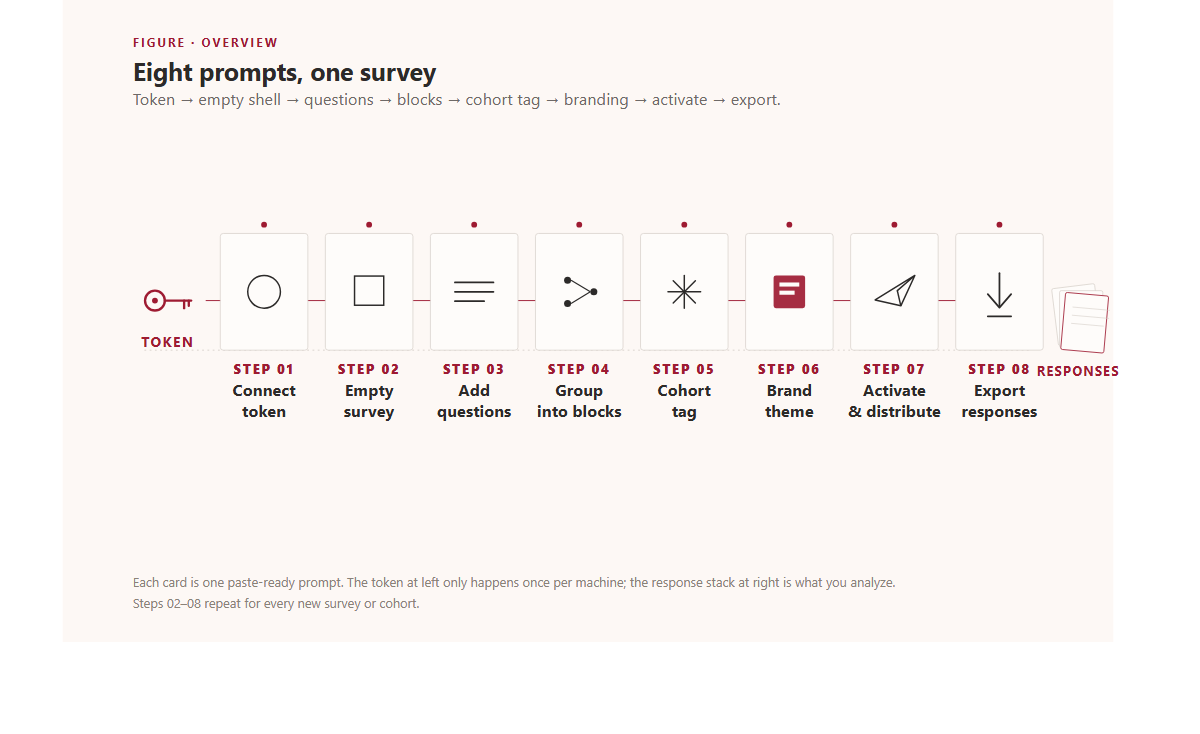
Build Qualtrics surveys by talking to Claude Code →
Eight prompts you can paste into Claude Code (or Codex CLI), in order, to go from a fresh API token to live response export — without writing code yourself. Each step shows the prompt, what the assistant does in reply, and what you see as a result. Closes with one applied case: a TeachPlay perception × efficacy survey for the AI-Enhanced Educational Game Design microcredential.
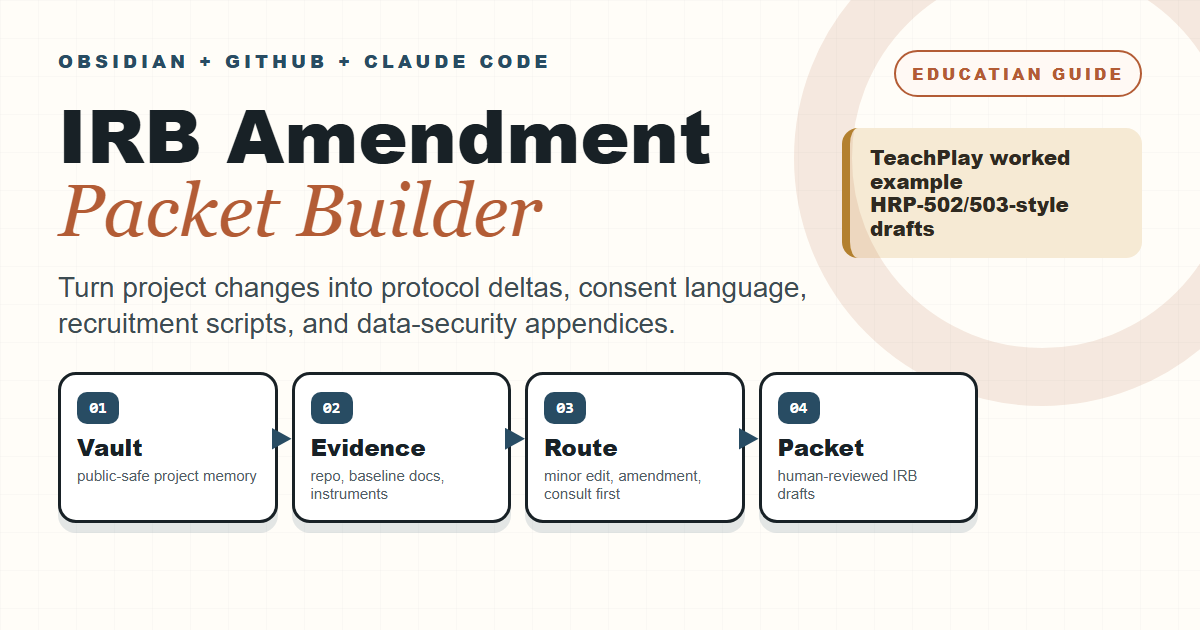
IRB Amendment Packet Builder →
Turn Obsidian vault project memory, GitHub repo traces, existing IRB baselines, and survey/API records into HRP-502/503-style amendment drafts. Includes a TeachPlay worked example, reviewer-logic map, AI/data-security wording, protocol delta table, consent snippets, recruitment shell, and public-safe starter templates.
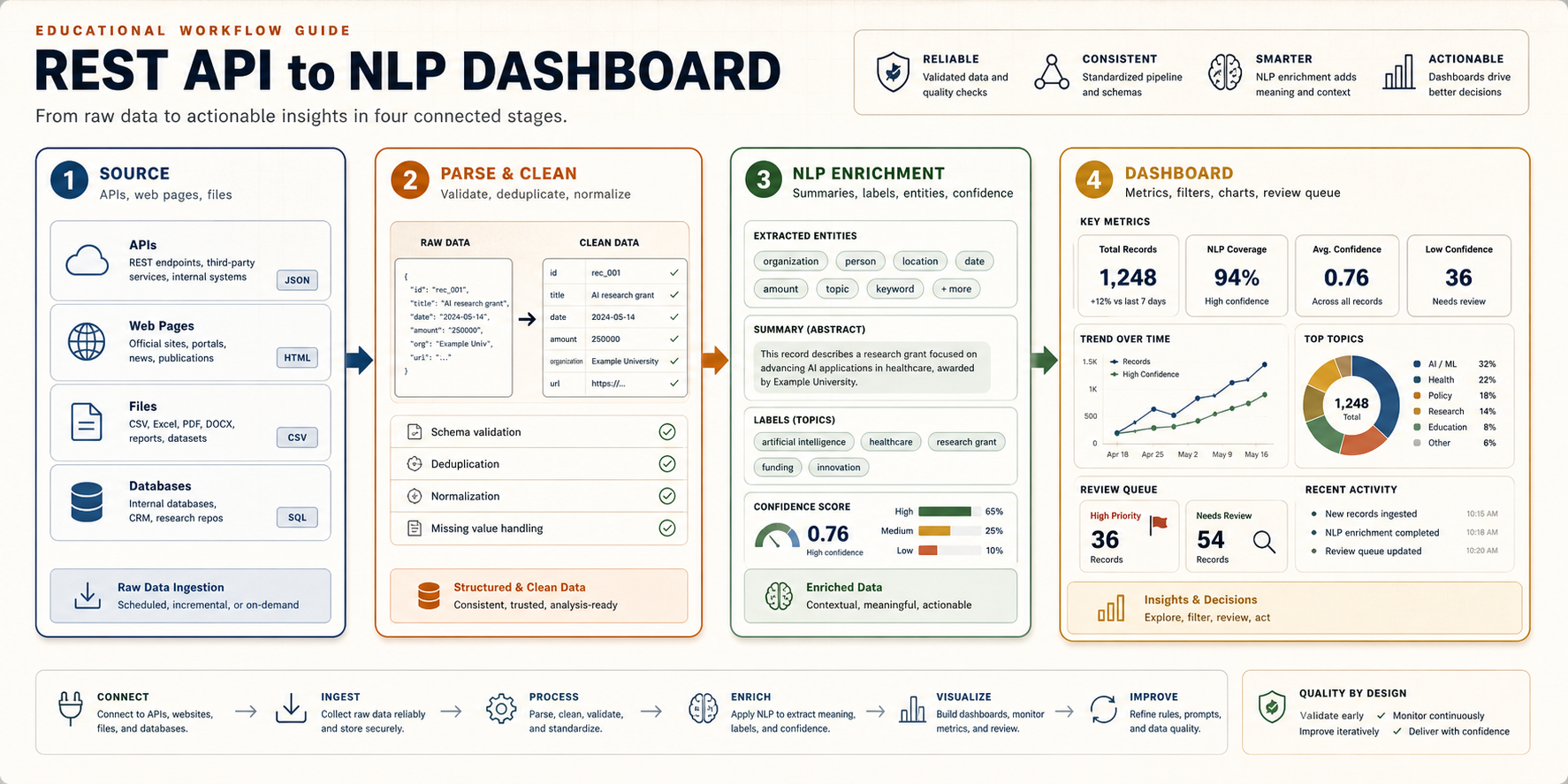
From REST API to NLP Dashboard →
A step-by-step bilingual guidebook for collecting REST API or public web data, parsing it into a stable data contract, running versioned NLP enrichment, and building a review-centered dashboard. Includes generated onboarding concept images, a five-step beginner map, FAQ, official references, and starter files for source registry, schema, and Python collection.
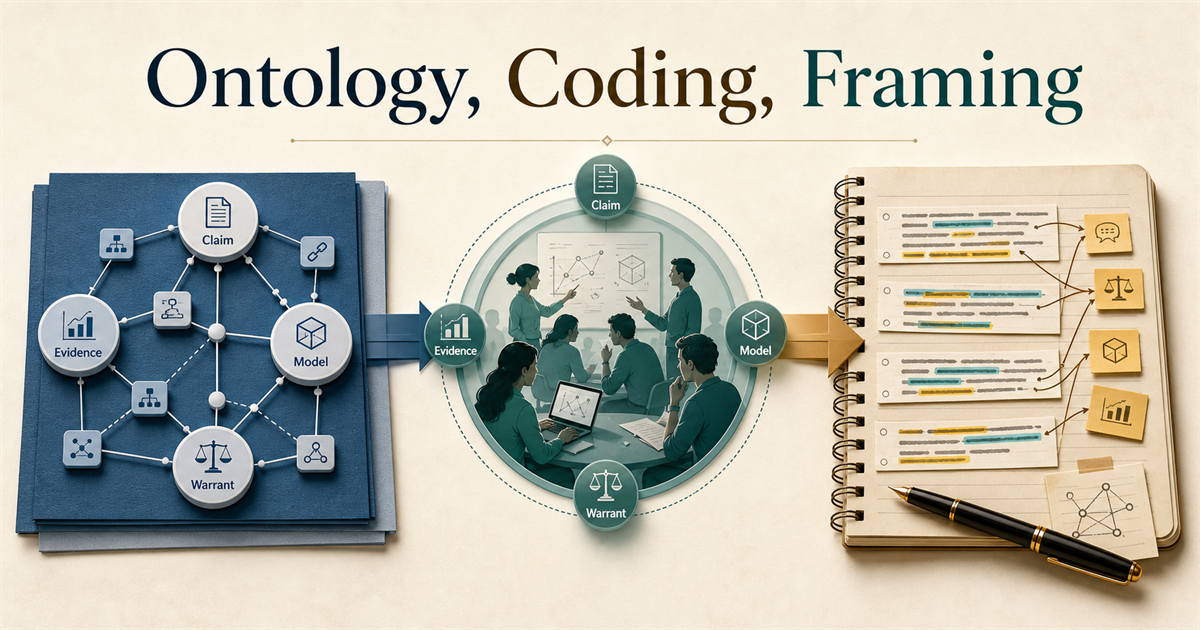
Ontology & Qualitative Coding Schemes →
A graduate AI researcher onboarding handbook on the epistemological bridge between formal ontologies and interpretive qualitative coding schemes. Covers shared structure, closed-world/open-world assumptions, reflexivity, coding misconceptions, accountable interpretation, SKOS backbones, and hybrid KG + ENA workflows. Includes an EN/KR toggle and a separate Korean companion page.
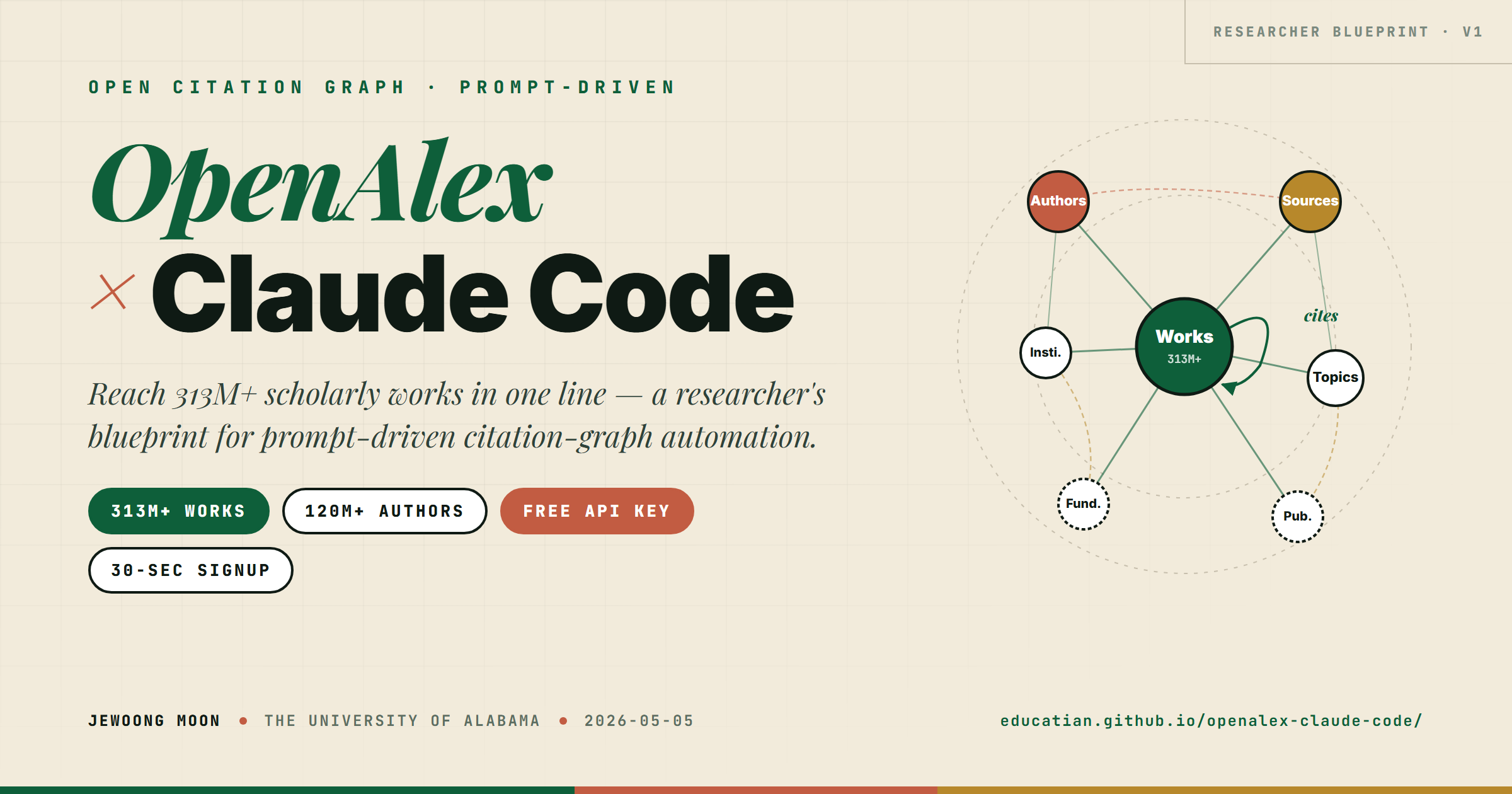
OpenAlex × Claude Code — a researcher's blueprint →
Reach 240M+ scholarly works in one line. A practical onboarding guide for prompt-driven citation-graph automation: OpenAlex basics (entity model, URL grammar, polite pool), three Claude Code integration patterns (direct prompt / helper script / MCP server), and a 5-step funnel for decomposing research ideas into API sequences. Includes a worked Discourse Lens v2 case study with the live v1 app embedded, a 30+ prompt library, beginner orientation chapter with a built-in glossary, and EN ↔ KO toggle.
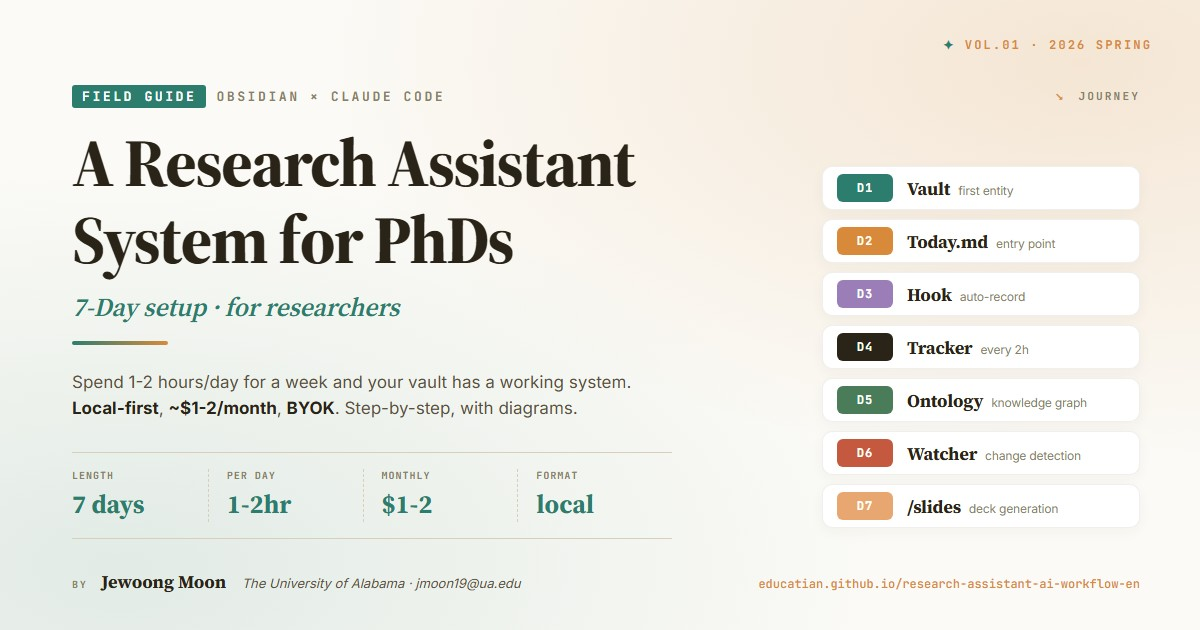
Research Assistant System — Beginner Tutorial →
A 7-day setup walkthrough for researchers building an AI-augmented knowledge management system with Obsidian and Claude Code. From a fresh laptop to a working personal vault that talks back — vault structure, daily logging, MCPs, slash commands, and CLI install for Claude Code + Codex. EN ↔ KO toggle in the top-right.
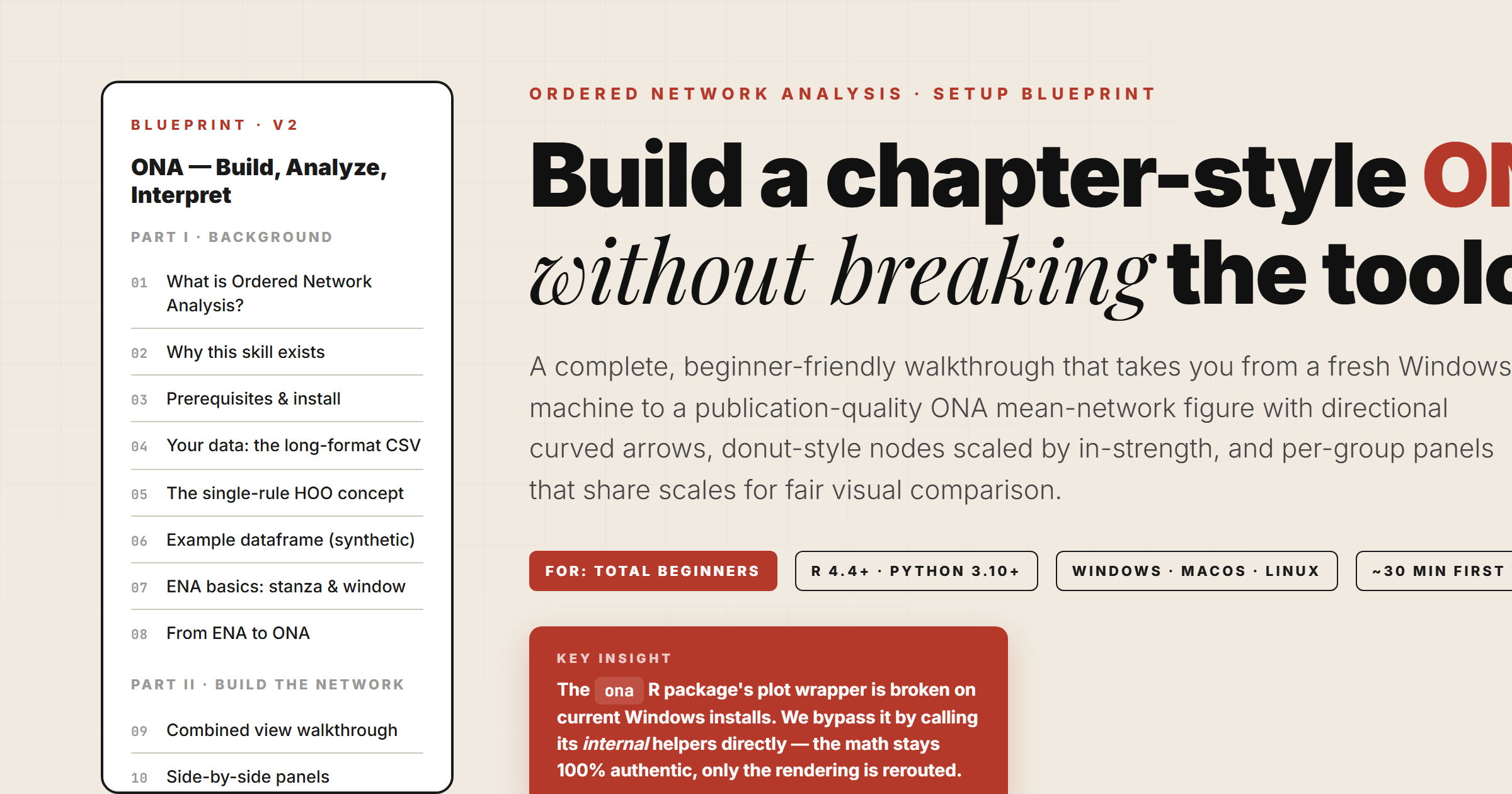
ONA in Practice — canonical figures for agentic workflows →
A more intuitive, workflow-first ONA guide: it introduces the original chapter and article foundations in detail, then turns them into reusable templates, troubleshooting rules, sanitized skill examples, and downloadable synthetic starter data for agentic analysis.
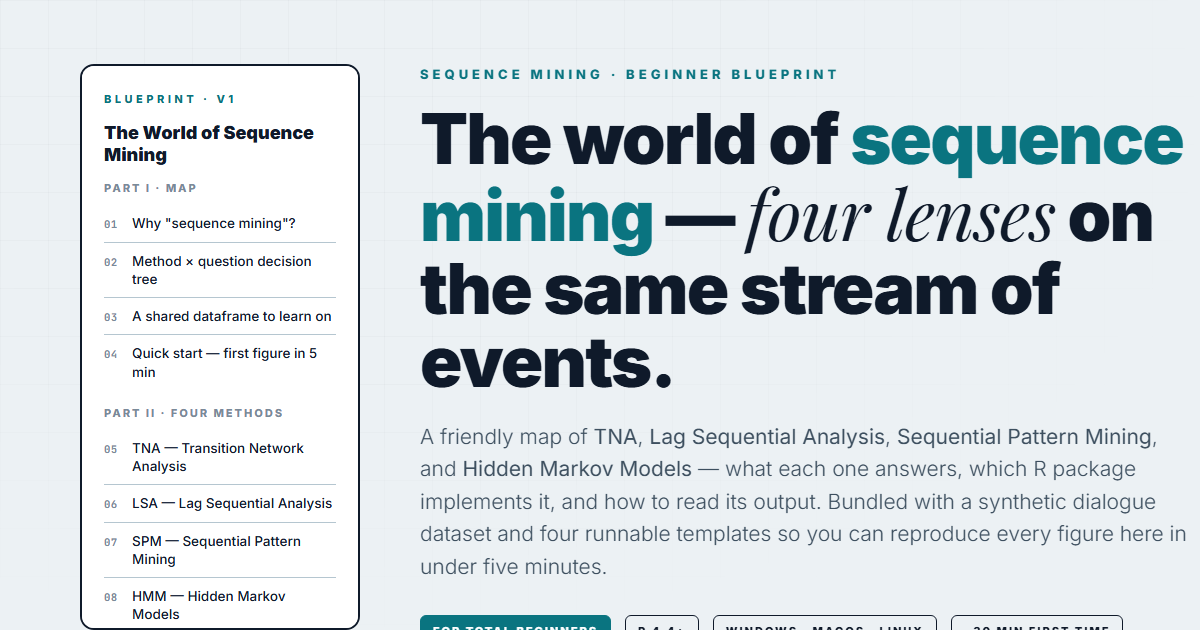
The World of Sequence Mining — TNA · LSA · SPM · HMM →
Four lenses on the same stream of events. Method × question decision tree, end-to-end R templates for each, bundled synthetic dataset, and a troubleshooting matrix. Cool-tone blueprint.
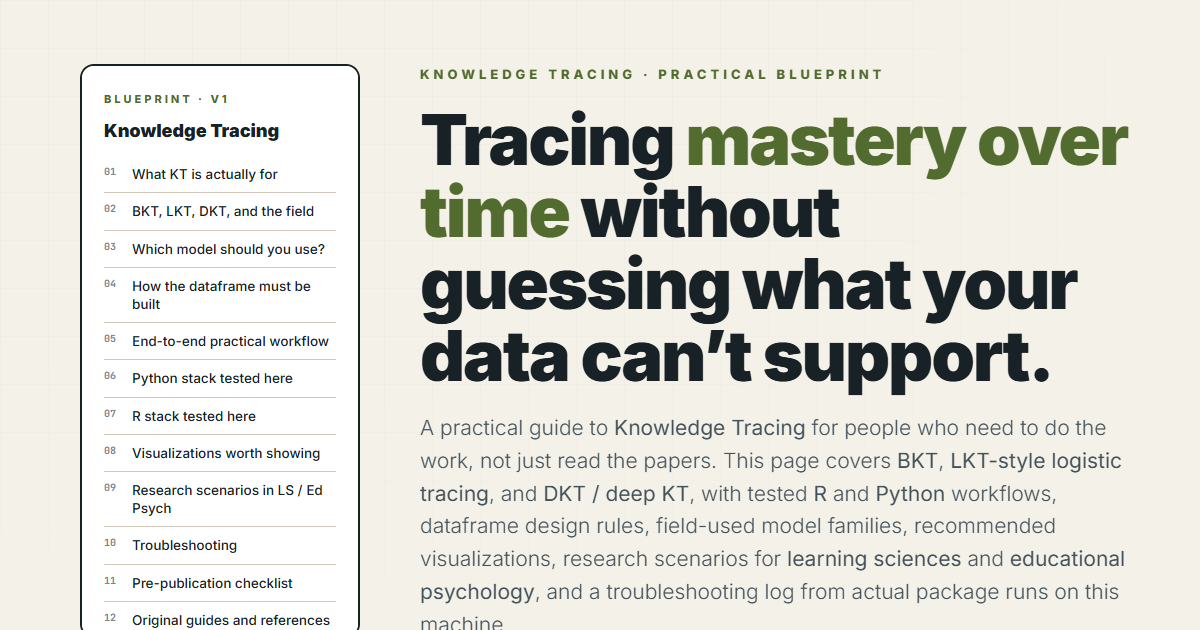
Knowledge Tracing Blueprint — BKT · DKT · R · Python →
A practical guide to tracing mastery over time: dataframe design, tested R/Python packages, field-used KT families, strong visualization choices, research scenarios for learning sciences and educational psychology, and troubleshooting from real package runs.
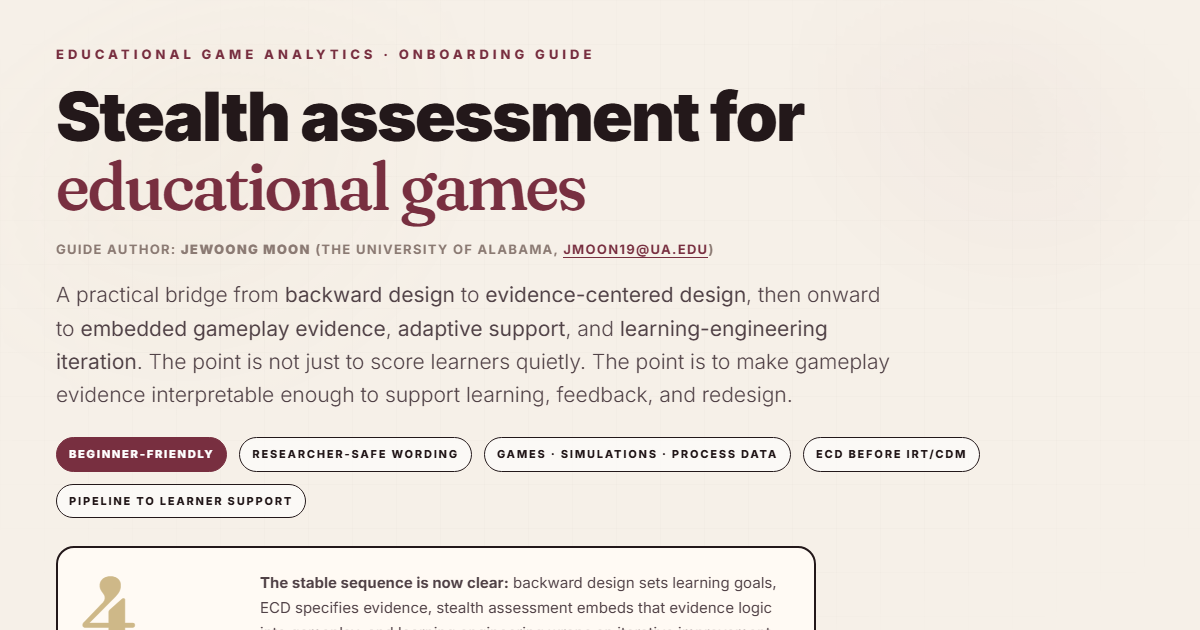
Stealth Assessment for Educational Games →
A bridge from backward design to ECD, then onward to stealth assessment and learning engineering. Focused on how gameplay telemetry becomes defensible evidence for feedback, adaptation, and redesign rather than just hidden scoring.
Presentations — published talk decks and thumbnails →
A living index of presentation folders under /presentations/. New decks appear here automatically when they include an index.html, with thumbnail previews when a thumbnails/ folder is present.
MVPs — working research instruments and learning tools →
A shelf of functional prototypes under /mvp/. Self-contained Next.js / Vite apps with their own data, state, and UI. Currently: databrief (HRD dashboard authoring + R bidirectional + 3-stakeholder AI critic + Decision Trace). New MVPs land here as /mvp/<slug>/.