Instructional design history / beginner snapshot
Jewoong Moon, Ph.D. The University of Alabama Instructional Technology Program jmoon19@ua.edu

From ISD to LDT

How instructional design grew from industrial and wartime training systems into AI-era learning design and technology. The point is not to memorize models. The point is to see why each model appeared, what problem it solved, and how the field expanded.

Origin: reliable training at scale Expansion: systems, environments, evidence Now: AI, analytics, accessibility
Four streams flowing into instructional systems design and expanding into learning design and technology Industrial training, military systems analysis, behavioral science, and measurement converge into ISD, which later expands into LDT. START WITH THE PROBLEM, NOT ADDIE How do we help many people learn important tasks reliably? Industrial training show / tell / do / check Military systems people / machines / procedures Behavioral science steps / response / feedback Measurement objectives / mastery / evidence ISD Instructional Systems Design analysis / design / development / evaluation LDT Learning Design and Technology learning sciences UX / analytics / AI
Opening mapISD is best introduced as a convergence of performance-training streams, not as a single model invented from nowhere.

ISD starts before ADDIE.

Instructional Systems Design became recognizable in the 1960s and 1970s, but its working logic is older. It grew from the need to prepare many people for consequential tasks in reliable, measurable ways.

1918-45

Industrial training

Job instruction made task performance teachable through demonstration, practice, and checking.

1941-50s

Military systems

Training became part of a whole system: people, machines, materials, procedures, and feedback.

1950s

Programmed instruction

Behavioral science gave designers small steps, active response, immediate feedback, and reinforcement.

1950s-60s

Measurement

Objectives, taxonomies, and criterion-referenced testing made learning outcomes inspectable.

1950s-70s

Instructional media

ETV, ITV, videotape, CAI, and PLATO made delivery, interaction, and distance part of the design problem.

Beginner takeaway

Instructional design did not begin as "pretty course content." It began as a performance-design question: what should learners be able to do, under what conditions, through which media or support system, and how will we know?

Archival instructional design studio with training manuals, film reel, flowcharts, and modern learning design tools
Generated visualA tactile origin image for the guide: ISD as training media, systems diagrams, measurement, and later digital design work on one desk.
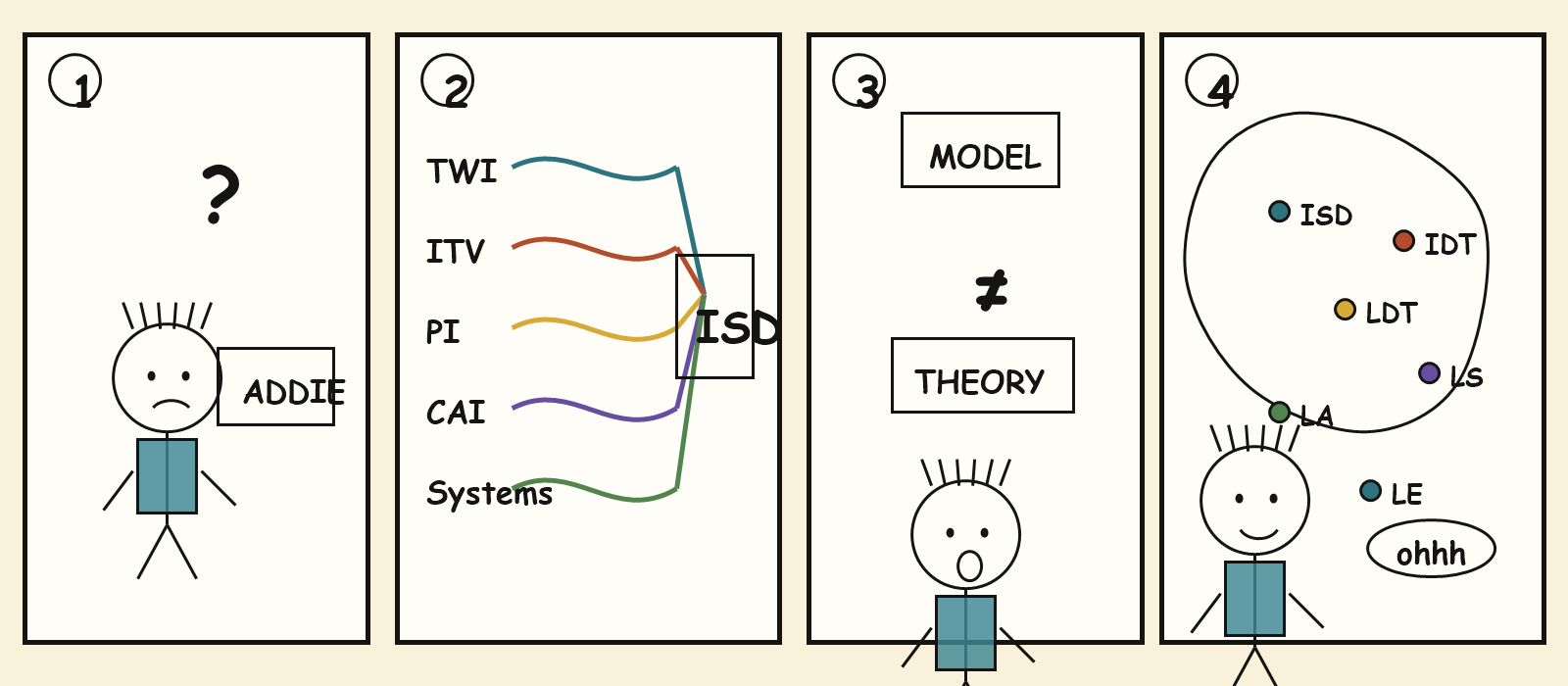
Four-panel doodle comic about a beginner learning that instructional design is more than ADDIE
Generated comicA deliberately rough four-panel doodle that makes the beginner misconception memorable: ADDIE is useful, but the field is larger than one model.

The design object kept getting larger.

The field's history is easier to understand if we ask, "What are designers designing?" The answer moved from media and lesson sequences toward whole environments, platforms, and AI-supported systems.

Rung 1

Media and audiovisual instruction

Make content visible, distributable, and reusable through film, radio, ETV, ITV, and later videotape.

Rung 2

Programmed sequences

Guide response, feedback, reinforcement, and developmental testing.

Rung 3

CAI and networked learning

Use mainframes, TICCIT, and PLATO to make instruction interactive, adaptive, and shareable.

Rung 4

Instructional systems

Align goals, learners, tasks, assessment, strategy, and revision.

Rung 5

Learning environments

Support inquiry, collaboration, identity, and meaningful activity.

Rung 6

Digital ecosystems

Connect platforms, content, dashboards, discussion, and support.

Rung 7

AI-supported products

Co-design adaptive, ethical, learner-facing systems.

Rung 8

Learning engineering

Continuously improve learning systems with theory and evidence.

Read decades as design problems.

This is not a complete history. It is a beginner map: each era had a pressure, and the field answered with a design response.

Interactive ISD to LDT lineage graph A conceptual graph with time on the horizontal axis and lineage lanes for training systems, media technology, psychology and measurement, design research, and digital learning systems. Training Media / CAI Psychology Systems ISD Research Digital / AI 1918195219601970s1990s2010s2020s Allen / TWI1918-45 ETV / ITV1952-60s Skinner / PI1954-60s CAI / PLATO1960-70s Job Corps / ESEA1964-65 Gagne / Glaser1965-70s FSU / IPISD1970s Models1980s Web / DBR1990s Learning env.2000s Analytics2010s AI-era LDT2020s
1918-45

Train workers and soldiers fast

Standardize job instruction, task analysis, practice, and checking.

Allen / TWI
1918-45

Train workers and soldiers fast

Standardize job instruction, task analysis, practice, and checking.

Allen / TWI
1952-60s

Broadcast instruction at scale

Canada and the USA test whether ETV/ITV lectures, demonstrations, field trips, and visualization can travel beyond one classroom.

EEN / MPATI / ITV
1954-60s

Make instruction precise

Teaching machines and programmed books turn response, feedback, and revision into a design process.

Skinner / PI
1960-70s

Make computers instructional

CAI, TICCIT, and PLATO prototype drill, tutorials, branching, authoring languages, and online community features. PLATO I went live at the University of Illinois in 1960 under Donald Bitzer.

Stanford CAI / PLATO
1964-65

Create a learning industry

Job Corps, ESEA, and HEA funding create demand for self-instruction, systems models, and development projects.

Job Corps / ESEA / HEA
1965-70s

Match instruction to outcomes

Learning conditions, objectives, and formative revision connect psychology with systems design.

Gagne / Glaser / Briggs
1970s

Build accountable systems

FSU's defense work and IPISD make procedural ISD dominant in military and training contexts.

FSU / Branson / IPISD
1980s

Formalize the profession

Dozens of ISD models circulate and gain wide adoption; instructional design becomes the core competency of instructional technology. Dick & Carey first appears in 1978 and dominates through the 1980s; Reigeluth's edited volume on instructional-design theories follows in 1983.

Dick & Carey / Reigeluth
1990s

Challenge delivery-only design

Constructivist critique, the Web, and design experiments push designers toward authentic activity and context.

WWW / Jonassen / DBR
2000s

Design learning environments

Learning sciences and online learning expand the design object beyond lessons and materials.

Sawyer / Merrill
2010s

Instrument digital ecosystems

Analytics, dashboards, UX, and learning engineering make evidence loops part of LDT work.

Siemens / OpenSimon
2020s

Design with AI responsibly

LDT work includes AI, accessibility, privacy, analytics, products, and governance.

AECT 2023 / GenAI
Model history

ADDIE is later shorthand

The field had systems procedures before the acronym became a common way to name the phases.

Field language

Technology was soft and hard

It meant both scientific process design and physical media/devices.

Adoption lesson

Access did not equal use

Film, ITV, computers, and networks repeatedly showed that hardware adoption alone does not transform pedagogy.

Current stance

ISD absorbed critique

Constructivism and SAM challenged rigid use, but not the broader need for alignment, evaluation, and revision.

Models are tools, not religions.

A beginner mistake is to ask which model is "best." A better question is: what kind of design problem do you have?

Selected tool

ADDIE / IPISD

Use it when the project needs accountable phases: analyze, design, develop, implement, evaluate. Watch out for treating phases as a rigid waterfall.

Model chooser matrix

Read across the problem, not down a ranking. Filled dots mean the model is especially useful for that design problem; open dots mean it can help but is not the main fit.

Problem type
ADDIE / IPISD
Dick & Carey
Gagne
Merrill
DDR
DBR
Learning Eng.
Accountability
Lesson support
Authentic task
Complex environment
Continuous improvement
AI product / platform
primary fit useful fit supporting fit
Confusion decoder

Beginners often hear model, theory, framework, method, and research design used as if they were interchangeable. In this guide, the distinction is practical: what question does the term help you answer?

Term people confuseQuestion it answersExamples in this guideCommon mistake
Learning theoryHow do people learn?Behaviorism, cognitive views, constructivist views, learning sciencesTreating a theory of learning as a step-by-step course design recipe.
Instructional theory / principleWhat methods help learning, and under what conditions?Gagne's conditions, Merrill's First Principles, Reigeluth's instructional theoriesCalling every practical model a theory, or missing that some theories are prescriptive.
ID model / process modelHow should designers organize the work?ADDIE/IPISD, Dick & Carey, KempTreating ADDIE as a learning theory or as the single origin of ISD.
FrameworkWhat categories help us see the problem?AECT definitions, UDL, TPACK, program-identity lensesUsing a framework as if it automatically tells you what to build next.
Strategy / methodWhat action happens in instruction?Demonstration, practice, feedback, worked examples, simulation, discussionConfusing an activity with the larger design model that organizes it.
Research approachHow do we study the design or its effects?DDR, DBR, evaluation, learning analyticsUsing DBR for every iterative project; DDR is often the closer ISD/IDT fit for product, tool, model, or process development.
Media / toolWhat carries or supports the learning experience?ITV, CAI, PLATO, LMS, dashboards, AI toolsAssuming a new medium automatically changes pedagogy.

LDT did not replace ISD. It expanded the workspace.

Classic ISD desk

  • Needs analysis
  • Task analysis
  • Performance objectives
  • Criterion-referenced assessment
  • Instructional materials
  • Formative evaluation

Contemporary LDT studio

  • Learning sciences and design research
  • UX research and prototyping
  • Accessibility and inclusive design
  • Learning analytics and evaluation
  • AI-assisted design workflows
  • Ethics, privacy, portfolio, internship
Program lens

Modern LDT programs still need the ISD core: analysis, alignment, design, development, implementation, and evaluation. What changed is the setting. Designers now often work on platforms, products, analytics systems, simulations, microcredentials, and AI-supported learning environments.

Conceptual quadrant map of adjacent learning design fields A conceptual point map. Horizontal axis moves from explanation and study toward design and build. Vertical axis moves from local instruction and artifacts toward system-level data, infrastructure, and improvement. Explain / study learning Design / build interventions Local instruction / artifacts Systems / data / infrastructure Theory and empirical explanation Learning systems engineering Classroom/tool use studies Instructional design practice Conceptual orientation map, not a ranking or measured score ISD LDT Learning Sciences Learning Analytics Learning Engineering Tech Integration
Selected field orientation

ISD

Center of gravity: analysis, alignment, development, implementation, evaluation, and revision of instruction as a system.

Which field are you actually asking about?

This is a quick sorting guide, not a boundary police tool. Many projects sit across fields, but the first question usually reveals the center of gravity.

If your question is...

How do teachers, programs, or schools adopt and use technology?

Start with technology integration, implementation, teacher practice, organizational conditions, or change research.

If your question is...

How does learning happen in context?

Start with learning sciences: cognition, social interaction, tools, discourse, culture, identity, and designed environments.

If your question is...

What should we design, develop, implement, and evaluate?

Start with ISD/LDT: needs, learners, goals, tasks, strategies, media, products, accessibility, implementation, and revision.

If your question is...

What can traces and evidence loops tell us?

Start with learning analytics or learning engineering, depending on whether the emphasis is analysis/insight or continuous system improvement.

What counts as evidence?

Fields differ not only by vocabulary but by the evidence they trust. This helps beginners understand why the same project can be reviewed differently by different communities.

ISD / IDT

  • Needs and task analysis
  • Goal-assessment alignment
  • Formative evaluation data
  • Usability and implementation evidence
  • Revision rationale

LDT

  • Prototype and design rationale
  • Learner experience and access
  • Learning outcomes and transfer
  • Technology affordance evidence
  • Program or product implementation

Learning Sciences

  • Mechanisms of learning
  • Discourse and interaction
  • Conceptual change
  • Situated activity and culture
  • Design-based theory refinement

Learning Analytics

  • Trace-data validity
  • Model fit and uncertainty
  • Dashboard interpretation
  • Actionability for learners/instructors
  • Ethical data use

Learning Engineering

  • Instrumented improvement cycles
  • A/B or quasi-experimental evidence
  • Learning-science alignment
  • Operational metrics
  • Scalable revision infrastructure

Technology Integration

  • Teacher practice and beliefs
  • Adoption conditions
  • Organizational support
  • Classroom implementation
  • Equity and access in use
AI co-design

Prompt, critique, verify

Designers use AI to draft, simulate, personalize, and evaluate, while keeping responsibility for evidence and ethics.

UX / product

Prototype the experience

LDT work now often includes wireframes, user research, usability testing, and product-like iteration.

Accessibility

Design for access first

Inclusive design, UDL, captions, alt text, remediation, and policy compliance become core design responsibilities.

Analytics

Instrument the system

Learning traces, dashboards, assessment evidence, and improvement cycles connect design to measurable use.

Learning engineering

Improve continuously

The object is not one course artifact; it is a learning system that can be tested, revised, and governed.

Ethics

Govern the technology

Privacy, bias, transparency, copyright, labor, and accessibility shape what counts as good design.

Side-by-side visual of a classic ISD desk expanding into a contemporary LDT studio
Generated visualThe left side keeps the classic ISD desk; the right side shows the LDT studio: prototypes, analytics, accessibility, collaboration, and AI-era design work.

What does this field become as actual work?

For beginners, the bridge from LDT programs to jobs is often unclear. This prototype uses public occupational data as the stable baseline, then leaves a job-board API slot for live postings from sources such as HigherEdJobs, Glassdoor-style providers, or institutional HR feeds when access is available.

$74.7K2024 median pay
21.9Kannual openings
+2.9Knet jobs, 2024-34
MA+typical entry signal

Role composition: not just content production

Heuristic synthesis from O*NET task/work-activity categories and BLS occupation framing. It is a guide visualization, not a job-posting frequency estimate.

Analysis18 Collaboration20 Curriculum17 Technology16 Evaluation12 Faculty/support10 Media7
Projected employment curve for instructional coordinators from 2024 to 2034 BLS projects employment from 232.6 thousand in 2024 to 235.5 thousand in 2034, a slow 1 percent increase. Employment stock projection, ID proxy occupation BLS 25-9031 Instructional Coordinators, 2024-2034 2024 2034 232.6K 235.5K slow growth: +2.9K total jobs over ten years

Baseline source: O*NET 25-9031.00, updated 2026. The older 25-9031.01 Instructional Designers and Technologists code now redirects to Instructional Coordinators, so the chart labels keep the ID/LDT interpretation visible.

How to read the chart

The modern instructional designer is not only a course builder. The work clusters around relationship management, faculty/staff coaching, technology-mediated design, analysis/evaluation, documentation, and product-like learning systems. The qualification signal is graduate-heavy: BLS lists a master's degree as the typical entry-level education for the proxy occupation, while O*NET reports a Job Zone 5 occupation requiring extensive preparation.

Where did long-running ISD/LDT lineages take root?

This map uses a conservative guide criterion. The ISD/LDT layer prioritizes R1 universities with visible AECT/IDT/LDT field participation or strong instructional design, instructional technology, educational technology, instructional systems, or LDT graduate-program identity. The LS layer is separate and marks US learning-sciences programs or NAPLeS-listed/LS-oriented programs. A marker does not mean the same department, degree, or faculty line continued unchanged; reconfigured cases are labeled as legacy-to-current identity transitions rather than simple continuity claims.

33first-pass R1 ID/LDT/LT training institutions
R1research university filter, not program quality ranking
Activeofficial graduate program/concentration pages checked
Read the map this way

This is a lineage visualization, not a ranking. It separates age/confidence of the program lineage from identity of the lineage: some programs remain closer to systems ISD, some to educational technology research, and some moved toward learning sciences or LDT design-studio identities. Dashed shift markers are interpretive and need archive-level confirmation before publication-grade claims.

1960 to 2026 identity river for ISD, IT, LDT, and learning sciences A conceptual lane chart showing how selected programs are grouped by public-facing systems ISD, instructional technology, LDT, and learning sciences identities across time. Horizontal placement is approximate time / public identity cue. Vertical placement is categorical lane only, not a score. 196019751990200520202026 Systems ISD IT / EdTech LDT Learning Sciences FSU / IU Purdue ASU legacy Mizzou 1997 UF EdTech / TTU UGA / PSU ASU LDT Wisconsin / CU Stanford / Buffalo Conceptual grouping, not a measured scatterplot: labels summarize public-facing program identity. Archive confirmation is still needed for exact continuity claims.

Purdue

ISD
IT
LDT
LS

ASU

ISD
IT
LDT
LS

Wisconsin

ISD
IT
LDT
LS

UF

ISD
IT
LDT
LS

Same university, different program identity

Click a case to see why the map sometimes gives one university two markers. The point is not inconsistency; it is that departments, concentrations, and intellectual communities can coexist inside the same R1 institution.

ID / organization layer

IDTO

Instructional Design, Technology, & Organization: ID plus organization development, workplace learning, project management, and evaluation.

same place
LS / digital environments layer

DELTA

Digital Environments for Learning, Teaching, and Agency: learning-sciences-oriented digital learning environments and agency.

UIUC should be read as a dual-layer case, not a single blended program identity.
Interactive map of long-running ISD and LDT program lineages in the United States United States state-boundary map with program pins for institutions with long ISD, IDT, educational technology, or LDT lineages. US states map / pins projected from campus latitude and longitude
Verified 30+ lineage Legacy likely / needs deeper archive Near-threshold or LDT-specific launch Legacy ISD/IT/EdTech now a current LDT/LS-oriented program US learning sciences program layer NAPLeS-listed / network-confirmed LS layer
Academic archive wall with a United States map and pins for institutional lineage mapping
Generated visualA supporting mood image for the interactive lineage map. The actual school locations remain coordinate-based in the SVG map above.

Same learning problem, different design assumptions.

Imagine one learner trying to operate a complex system. The field's history changes how that learner is supported.

1940s

Job instruction

The instructor demonstrates the task. The learner practices. The supervisor checks performance.

1950s

Programmed steps

The learner answers small frames and receives immediate feedback after each response.

1970s

ISD course

The course has objectives, prerequisite analysis, assessments, materials, and revision cycles.

1990s

Authentic scenario

The learner solves realistic problems with scaffolds, tools, and collaboration.

2010s

Digital ecosystem

The learner uses LMS resources, simulations, peer discussion, and dashboards.

2020s

AI-era LDT

The learner receives adaptive AI support while designers monitor evidence, ethics, and access.

Terms in plain language.

TermBeginner definitionWatch out
ISDA systematic way to design instruction as a performance system.Not just a checklist or a course template.
ADDIEA common phase logic for organizing design work.Not the whole field and not necessarily the origin.
IDTInstructional design and technology: design plus processes/resources for learning.Technology means more than devices.
LDTLearning design and technology: designing learning experiences, environments, products, and programs.Not just edtech tool adoption.
ModelA representation or workflow that helps organize design decisions.Models can be useful without being theories of learning.
TheoryAn explanation or prescription about learning or instruction under certain conditions.Do not call every process diagram a theory.
FrameworkA set of categories or lenses for seeing a problem.A framework helps organize thinking; it may not tell you the next design step.
DDRDesign and Development Research: an IDT research tradition for studying product/tool development and model development.Closer to ISD/IDT development work than DBR when the central object is a designed product, tool, model, or process.
DBRDesign-Based Research: iterative design and theory-building in real learning settings.Often closer to learning sciences; do not use it as the only research-design label for ISD work.
Learning sciencesResearch on how people learn across cognitive, social, cultural, and technological settings.It is not a single model.
Learning engineeringContinuous improvement of learning systems using learning science, data, and design.More data is not automatically better learning.
ETV / ITVEducational or instructional television used to distribute lectures, demonstrations, visualization, field trips, and other instructional genres.Early projects often overestimated how much broadcasting alone could replace local teaching.
CAIComputer-assisted instruction: early computer-delivered drill, tutorials, branching, and later more adaptive instruction.Do not treat all educational computing as CAI; later computers also became learner productivity and communication tools.
PLATOUniversity of Illinois networked instructional computing system that combined courseware with many features later associated with online communities.It was not just a tutoring system; it also matters as a platform and community precedent.
Soft technologyThe application of scientific/systematic thinking to design, development, testing, and revision.In IDT history, technology does not only mean hardware.
IPISDInterservice Procedures for Instructional Systems Development, a major 1970s military ISD procedure set.It is a lineage anchor for ADDIE-like phase logic, not the whole origin story.
Developmental testingRepeated tryout, error detection, feedback, and revision during material development.This is why programmed instruction mattered even after the format itself faded.

Beginner worksheets that make the history usable.

Worksheet 1

Origin streams

Match industrial training, military systems, behaviorism, measurement, and instructional media to their design contributions.

Worksheet 3

Model comparison

Compare ADDIE, Dick & Carey, Kemp, Gagne, Merrill, DBR, and learning engineering.

Worksheet 6

Program anatomy

Sort classic ISD, transitional IDT, and contemporary LDT components.

Draft companion file

The current worksheet pack lives locally at Desktop/_writing/2026-05-06_isd-to-ldt-worksheets/worksheets.md. In a later pass, this guide can link a clean downloadable PDF or printable HTML version.

Common beginner confusions.

Did instructional design start with ADDIE?
No. ADDIE is a widely used phase logic, but ISD's roots include industrial training, military systems analysis, behavioral psychology, and measurement. ADDIE-like procedures became prominent after these streams had already converged.
Is LDT just a new name for instructional design?
Not exactly. LDT keeps the ISD concern for alignment and evaluation, but expands toward learning sciences, technology design, user experience, analytics, accessibility, ethics, and product/program implementation.
Are systems models outdated?
No. They are still useful when reliability, alignment, accountability, and evaluation matter. The problem is not systems thinking; the problem is using a model rigidly when the learning context requires iteration.
How is IDT/LDT different from general technology integration research?
Technology integration research often asks how teachers, schools, or organizations adopt and use technologies in practice. IDT/LDT can study that too, but its distinctive center is design: analyzing a learning or performance problem, choosing instructional conditions, developing materials/tools/environments, implementing them, evaluating effects, and revising the system. In short, technology integration may foreground adoption and classroom use; IDT/LDT foregrounds intentional design, development, alignment, and improvement of learning systems.
Will AI replace instructional designers?
AI changes drafting, media production, feedback, adaptation, and evaluation workflows. But human designers remain responsible for goals, learner context, evidence, equity, privacy, and instructional judgment.

References should teach the lineage, not sit at the bottom.

This draft treats sources as an interactive map. Filter by lineage to see which references support each part of the guide. The role labels are intentionally practical: they explain why a beginner should care about the source.

Field venues to watch

For the IDT/LDT side of the field, these journals and conferences are useful entry points for current research, design cases, and professional conversations. Learning-sciences venues are intentionally left for a later layer so the guide does not blur the two traditions too quickly.

Springer thumbnail
Journal / flagship research

Educational Technology Research and Development

A central AECT-linked research journal for instructional design, learning technologies, development, evaluation, and theory-facing IDT work.

Journal
Springer thumbnail
Journal / field trends

TechTrends

AECT-linked venue for current issues, applications, professional practice, and emerging technology conversations in educational communications and technology.

Journal
Indiana University ScholarWorks thumbnail
Journal / design cases

International Journal of Designs for Learning

Useful for design knowledge in case form: what designers made, why they made it, and how design decisions unfolded.

Journal
Springer thumbnail
Journal / formative design

Journal of Formative Design in Learning

Focuses on formative design, iterative improvement, learning design, and development-oriented inquiry.

Journal
EdTech Books thumbnail
Journal / applied ID

Journal of Applied Instructional Design

Practice-facing ID venue for applied design, development, evaluation, and workplace/higher-ed instructional design cases.

Journal
AECT thumbnail
Conference / IDT home base

AECT Convention

Primary professional/research home for educational communications, instructional design, educational technology, and IDT program communities.

AECT
AACE thumbnail
Conference / edtech research

SITE, EdMedia, and E-Learn

AACE conferences that often surface educational technology, teacher education technology, online learning, multimedia, and design-development work.

AACE conferences
ATD thumbnail
Conference / workplace L&D

ATD

Useful for connecting instructional design to corporate learning, talent development, workplace learning systems, and practitioner language.

ATD
Start here

Origins: why ISD appeared

Start with the pressure that made systematic design necessary: training many people for consequential tasks with observable performance and feedback.

  • Molenda gives the historical spine.
  • Industrial training and military systems explain the performance-and-systems logic.
  • Programmed instruction, ITV, CAI, and PLATO show why media and process both belong in IDT history.
Reading strategy: click the pathway first. Use filters only when you want to inspect the supporting source cards behind one phase of the story.
2026occupation baseline

O*NET 25-9031.00 - Instructional Coordinators

Stable public source for ID/LDT-adjacent tasks, work activities, technology categories, and reported titles. O*NET notes that the older Instructional Designers and Technologists code redirects here.

Open source
2025wage / outlook

BLS Occupational Outlook Handbook - Instructional Coordinators

Source for the job-market snapshot: 2024 median pay, annual openings, projected growth, major employers, and similar occupations.

Open source
1918-1970shistory spine

Molenda (2023) - History and development of instructional design and technology

Backbone source for the guide's corrected historical spine: audiovisual instruction, ETV/ITV, programmed instruction, CAI/PLATO, wartime training, military systems, ISD, and distance/online education.

Open source
1940s-2020sindustrial training

Training Within Industry lineage

Supports the industrial-training tributary: standardized job instruction, show-tell-do-check logic, and continuous-improvement culture later associated with industrial training practice.

Overview
1954programmed instruction

Skinner (1954) - The science of learning and the art of teaching

Use this to explain the behaviorist design contribution: small steps, active response, immediate feedback, and reinforcement.

Record
1960-2000sCAI / online community

PLATO history archive

Use this to ground the CAI/platform branch: networked terminals, instructional authoring, message boards, email-like communication, chat, remote sharing, and early online community.

Archive
1965learning conditions

Gagne (1965) - The conditions of learning

Bridge source from training psychology to instructional design: different outcomes require different internal and external learning conditions.

Archive record
1975ADDIE lineage

Branson et al. (1975) - Interservice procedures for instructional systems development

Key military ISD source for the procedural systems-development logic behind later ADDIE-style workflows.

DTIC record
1977 / 2023field definition

AECT definitions - educational technology as theory, design, resources, and evaluation

Use this to show the field's self-definition moving beyond devices toward strategic design, management, implementation, and evaluation.

AECT definition
1978system model

Dick & Carey (1978) - The systematic design of instruction

The clearest model for teaching beginners that goals, learners, objectives, assessments, strategy, materials, and evaluation form one system.

WorldCat
1983instructional theory

Reigeluth (1983) - Instructional-design theories and models

Useful for explaining that ID is not only procedure; it also includes prescriptive theory about sequencing and conditions.

Book page
2003ADDIE caution

Molenda (2003) - In search of the elusive ADDIE model

Useful caution for beginners: ADDIE is best treated as a common phase logic, not as the whole origin or a single canonical theory.

DOI
1992design experiments

Brown (1992) - Design experiments

Anchor for the learning-sciences turn: design as a way to study learning in realistic settings, not only produce materials.

DOI
1992anchored instruction

Cognition and Technology Group at Vanderbilt - Jasper Woodbury

Useful bridge from participatory instructional television and videodisc work toward problem-centered learning environments.

Vanderbilt context
1997constructivist design

Hannafin et al. (1997) - Grounded practice and constructivist learning environments

Good source for the shift from delivering instruction to designing environments with scaffolds, tools, and authentic activity.

DOI
2002task-centered ID

Merrill (2002) - First principles of instruction

A compact bridge from traditional ID to authentic, problem-centered learning: activation, demonstration, application, integration.

DOI
2007design/development research

Richey & Klein (2007) - Design and development research

Key IDT methods source for DDR: studying instructional products, tools, models, and development processes rather than treating every iterative design study as DBR.

Book page
2006learning sciences

Sawyer (2006) - The Cambridge handbook of the learning sciences

Use this to explain the broader learning-sciences expansion: cognition, social interaction, culture, tools, and design.

DOI
2013learning analytics

Siemens (2013) - Learning analytics: The emergence of a discipline

Reference for the 2010s shift toward data traces, dashboards, digital learning ecosystems, and analytics-informed design.

DOI
2010slearning engineering

CMU Simon Initiative / OpenSimon

Program-facing source for learning engineering: using learning science, data, and iterative improvement to refine learning systems.

CMU page
2023theory in analytics

Khalil, Prinsloo, & Slade (2023) - Learning theory in learning analytics

Useful caution for the current-trends section: analytics should be theory-informed, not just more data and dashboards.

DOI
2024generative AI

Choi et al. (2024) - Utilizing generative AI for instructional design

Recent peer-reviewed anchor for AI-era ID: strengths, weaknesses, opportunities, and threats in instructional design workflows.

DOI
2024dashboards

Paulsen & Lindsay (2024) - Learning analytics dashboards systematic review

Good current source for the claim that dashboards are increasingly expected to support learning, not only report analytics.

DOI
2025field trends

Reiser, Carr-Chellman, & Dempsey (2025) - Trends and issues in IDT

Use as the current field-map source: AI, alternative ID models, microcredentials, hybrid learning, ethics, accessibility, and IDT roles.

Book page
currentLDT example

Stanford Learning Design and Technology MS

Program example for showing how LDT now includes environments, products, programs, emergent technologies, evaluation, internship, and design projects.

Program page